School Uniform Bulk Order Guide for Principals & Trustees
- Last Updated at: Aug 17, 2026
- 7 min read min read

A school uniform bulk order requires more planning than simply selecting a design and placing a large purchase request. Principals and trustees need to consider fabric quality, student comfort, sizing, budgets, delivery schedules, and long-term supply consistency. Mafatlal School Uniforms helps institutions approach uniform procurement with a structured focus on quality, standardisation, and reliable supply for large student populations.
Whether a school is opening a new academic year, changing its uniform design, or replacing an existing supplier, the right procurement process can reduce costs and avoid last-minute issues. Browse the full range of school uniforms or go straight to our Bulk Order page to request a quote.
Why Schools Need a Structured Uniform Procurement Plan
Uniforms represent a school's identity and are worn regularly throughout the academic year. A poor-quality uniform can lead to frequent replacements, while inconsistent sizing can create unnecessary complaints from parents.
A planned school uniform bulk order helps schools:
- Maintain consistent colours and designs
- Control procurement costs
- Ensure adequate stock across sizes
- Plan delivery before the academic year
- Reduce repeated purchasing activities
- Maintain a consistent appearance across classes and campuses
For a school with 2,000 students, even a small error in size forecasting can create significant excess inventory or shortages. Therefore, planning should begin well before the uniforms are required.
Step 1: Finalise the Uniform Design and Specifications
Before approaching suppliers, the school should document every uniform component. This may include:
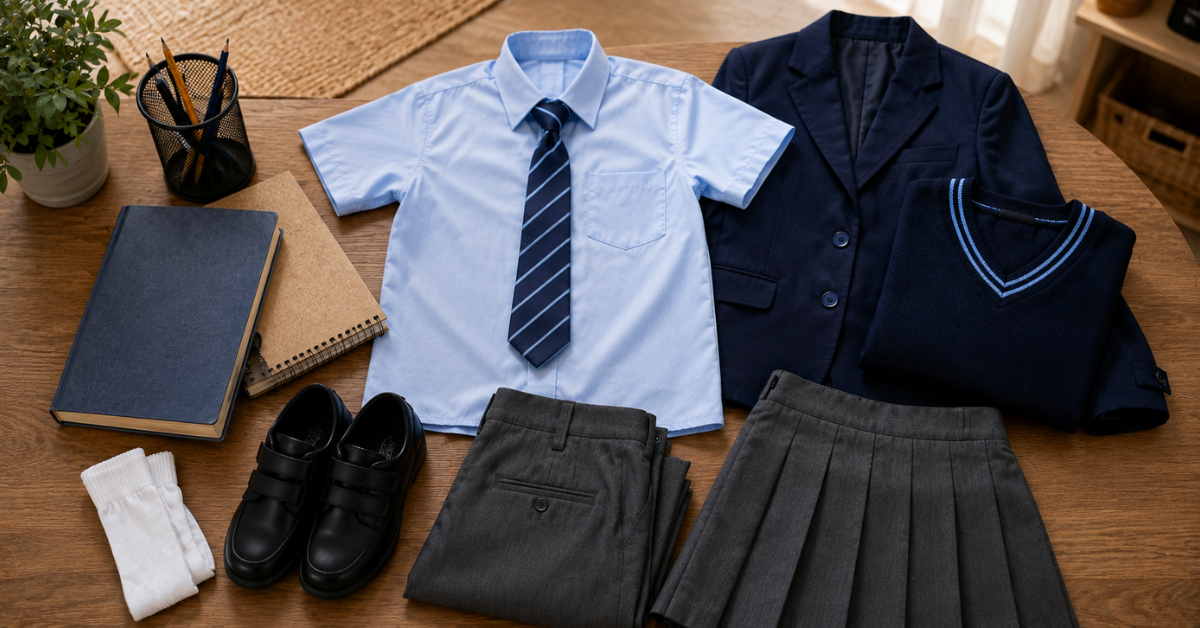
- Shirts and blouses
- Trousers (full pants), shorts, or skirts
- Blazers and sweaters
- Ties and belts
- Sports uniforms and polo T-shirts
- Socks and accessories
- House-specific apparel
The school should also finalise fabric composition, colour shades, stitching details, logo placement, buttons, trims, and other specifications.
Working with a custom school uniform manufacturer can be useful when the school requires a unique design rather than an off-the-shelf uniform. See how Mafatlal has executed custom, institution-specific uniform programmes for partner schools such as Jindal Vidya Mandir and Jindal Adarsh Vidyalaya.
Step 2: Estimate Quantities and Sizes
Accurate forecasting is one of the most important parts of bulk procurement. Schools should analyse:
- Current student strength
- New admissions
- Existing uniform inventory
- Expected replacement requirements
- Size distribution from previous years
- Additional requirements for staff or sports teams
Instead of ordering exactly according to student strength, schools should establish a reasonable buffer for replacements and late admissions. A detailed size chart and physical sample fitting can also help reduce incorrect orders — something our bulk order team helps institutions work through before production begins.
Step 3: Evaluate the Right School Uniform Supplier
Choosing the right school uniform supplier India is about more than comparing quotations. Principals and trustees should assess the supplier's manufacturing capacity, fabric sourcing, quality standards, delivery capabilities, and experience with institutional orders.
The supplier evaluation can include:
|
|
|
|
|
|
|
|
|
|
|
|
|
|
|
|
|
|
|
|
|
For schools searching online for a school uniform manufacturer near me, geographical proximity can be useful, but it should not be the only selection criterion. Production capability, quality, reliability, and delivery performance are equally important — read more about Mafatlal's manufacturing legacy, built over more than 120 years of textile experience.
Understanding the School Uniform Tender Process
Large schools, school groups, and educational institutions may follow a formal school uniform tender process to select suppliers. Many government and government-aided institutions in India now run this process through the Government e-Marketplace (GeM), the national public procurement portal used for transparent, competitive bidding.
A well-structured tender should clearly mention:
- Uniform specifications
- Fabric requirements
- Estimated quantities
- Size requirements
- Sample approval criteria
- Branding requirements
- Delivery locations
- Expected delivery dates
- Quality standards
- Payment terms
- Replacement conditions
Suppliers should be evaluated using consistent criteria rather than selecting the lowest quotation automatically.
Step 4: Prioritise Quality and Student Comfort
Uniforms are worn for several hours every school day. Fabric should therefore be comfortable, durable, breathable, and suitable for the local climate. Many institutional buyers also check fabric performance against the specifications published by the Bureau of Indian Standards (BIS) for textiles, which cover parameters like colour fastness and fabric strength.
Schools should inspect samples for:
- Fabric feel and weight
- Colour consistency
- Stitching quality
- Seam strength
- Shrinkage
- Colour fastness
- Wash durability
- Comfort during movement
For a school uniform bulk order, sample approval should happen before full-scale production begins. This reduces the risk of discovering quality issues after thousands of pieces have already been manufactured. Browse our school uniform collection — including shirts, half pants, and polo T-shirts — to see fabric and finish quality before you request samples.
Step 5: Plan Delivery and Distribution
Uniform procurement does not end when manufacturing is complete. Schools should establish how uniforms will reach students. The supplier and school can plan:
- Campus-wise quantities
- Class-wise size requirements
- Delivery batches
- Packaging and labelling
- Distribution dates
- Replacement stock
For schools with multiple campuses, centralised planning can help maintain consistency and simplify coordination.
Common Mistakes to Avoid
Principals and trustees should avoid:
- Selecting a supplier only on price
- Ordering without checking physical samples
- Ignoring previous size data
- Finalising designs too late
- Not keeping replacement stock
- Failing to define quality standards
- Leaving delivery schedules unclear
These issues can increase costs and create pressure for both school administrators and parents.
Why Mafatlal School Uniforms Can Be Considered
Mafatlal School Uniforms can support institutions looking for structured uniform solutions with attention to quality, design consistency, and large-scale requirements. As a custom school uniform manufacturer with over a century of textile manufacturing experience, we help schools move from specification and sampling to production and delivery with greater coordination.
For principals and trustees, the goal should be to create a procurement process that is transparent, predictable, and focused on long-term value. Get in touch with our team or request a bulk order quote to start planning your school's next uniform cycle.
FAQs
How early should a school place a bulk uniform order? Schools should ideally begin planning several months before the uniforms are required. This provides time for design finalisation, sampling, size forecasting, approvals, production, quality checks, and delivery. Starting early also leaves room to address unexpected production or logistics delays.
How should a school choose a uniform supplier? A school uniform supplier India should be evaluated based on fabric quality, manufacturing capacity, customisation, pricing, quality control, delivery reliability, and replacement support. Schools should review physical samples and supplier experience before confirming a large order.
What should be included in a school uniform tender? A school uniform tender process should include detailed specifications covering fabric, colour, design, quantities, sizes, branding, delivery timelines, quality requirements, pricing, payment terms, and replacement conditions. Clear specifications make supplier comparisons more transparent.
Is a custom school uniform manufacturer better for schools? A custom school uniform manufacturer can be beneficial when a school needs specific colours, designs, patterns, logos, fabrics, or sizing requirements. It allows the institution to create uniforms that align closely with its identity instead of relying on standard designs.
How can schools reduce bulk uniform procurement costs? Schools can improve cost efficiency through accurate quantity forecasting, consolidated purchasing, early planning, standardised specifications, and supplier comparison. A well-planned school uniform bulk order can also reduce repeated procurement and emergency purchases during the academic year.
Conclusion
A successful school uniform bulk order depends on careful planning rather than price alone. Principals and trustees should finalise specifications early, forecast quantities accurately, evaluate suppliers carefully, approve samples, define quality standards, and establish clear delivery schedules.
With the right school uniform manufacturer near me or a capable nationwide supplier, schools can create a procurement system that supports quality, consistency, student comfort, and predictable costs. Mafatlal School Uniforms can be considered by institutions seeking a structured approach to large-scale school uniform requirements — start your bulk order request here